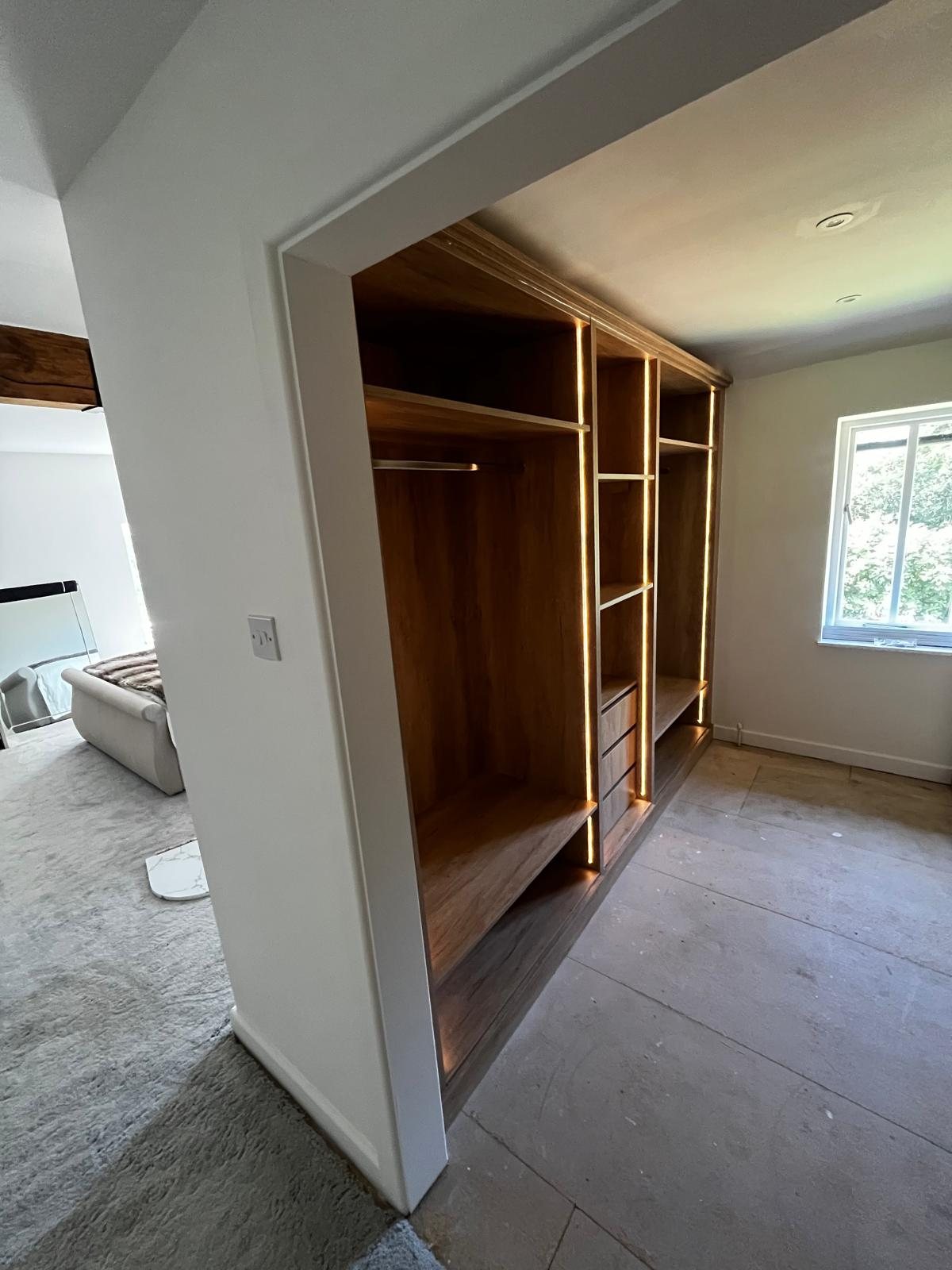
Fitted wardrobes are usually worth it if you are staying in the house for the medium to long term and your bedrooms have awkward or limited space, because they use room that freestanding furniture simply cannot reach. They are often not worth it if you move every couple of years or want the freedom to rearrange, because a fitted wardrobe is a fixture that stays with the house when you leave. That is the honest trade-off, and everything else follows from it.
The core difference is straightforward. A freestanding wardrobe is a piece of furniture built to a standard size that you take with you. A fitted wardrobe is built to the actual room, fixed to the walls, and runs into the spaces a standard carcass leaves empty. It fills the dead area above the doors up to the ceiling, closes into the alcoves beside a chimney breast, and follows the slope of a loft ceiling where nothing off the shelf will fit. In a small or oddly shaped bedroom, that reclaimed space is the whole argument. In a large, square, box-standard room, the case is weaker, because freestanding furniture already fits well and you keep the flexibility.
Where fitted wardrobes earn their money
The value is highest in exactly the rooms most people struggle with.
Small bedrooms, where a floor-to-ceiling run stores far more than a freestanding unit of the same footprint
Period properties with chimney breasts, where the alcoves either side are usually wasted by standard furniture
Loft conversions and rooms with sloped ceilings, where the eaves space is otherwise unusable
Rooms where a freestanding wardrobe would block a window, a radiator or a door swing
British homes are notoriously short on storage, and older Kent housing in particular is full of the awkward recesses and uneven walls that fitted joinery is designed to solve. This is where a fitted wardrobe stops being a luxury and starts being the only sensible way to use the space.
In our experience, a fitted wardrobe scribed to the wall works better than a freestanding unit pushed up against it because British walls are rarely flat or truly plumb, so a freestanding carcass leaves a wedge-shaped gap at the top or side that gathers dust and looks unfinished, whereas a scribed unit is cut to follow the actual line of the wall and closes tight to it. That single detail is the visible difference between fitted and freestanding, and it is why a good fitted run looks built-in rather than parked.
Where they are not the right choice
Fitted wardrobes are not for everyone, and it is worth being clear about who should think twice.
If you rent, they make no sense, because you would be improving someone else’s asset and leaving it behind. If you expect to move within a couple of years, the numbers rarely work, since you pay the full cost and take none of the furniture with you. And if you like rearranging your bedroom or think your needs will change, a fixed installation removes that freedom in a way freestanding furniture does not.
There is also a quality trap. A cheap, poorly fitted wardrobe looks worse than good freestanding furniture, because the whole appeal of fitted joinery is precision, and precision is the first thing lost when a job is rushed or built from the wrong materials.
What actually drives the cost and the quality
The price of a fitted wardrobe depends far more on how it is made than on how it looks on the day it goes in.
At the cheaper end are modular, flat-pack systems marketed as fitted. They use standard-width panels, which means the leftover inches in your recess are covered with filler strips rather than used. At the other end is a bespoke carcass built to the exact width and height of the space. From working with clients, we’ve found that the flat-pack route is a false economy in an awkward recess, because you pay for a fitted look and still lose the odd inches to packers and infill panels, which is the very space you were trying to reclaim.
Materials matter too. Carcasses are usually made from MDF or veneered board, which is stable and takes a paint or veneer finish well. Doors can be painted MDF, veneered, or solid timber. Solid timber looks beautiful but moves with changes in humidity, so in a bathroom-adjacent or poorly ventilated room a stable painted finish is often the more practical choice. On sliding designs, the running gear is where cheap installations fail first, so the quality of the tracks and rollers is worth more attention than the door finish.
Sliding doors are worth a specific mention. They save the swing space that hinged doors need, which makes them excellent in a narrow room where a hinged door would hit the bed. The trade-off is that you can only ever open half the wardrobe at once, and the gear costs more, so they solve a space problem rather than a storage one.
Getting the inside right
The outside gets the attention, but the inside decides whether the wardrobe is actually useful. A well-planned interior mixes full-height hanging for coats and dresses, double hanging for shirts and folded items, drawers, and adjustable shelves, rather than a single rail across the whole run.
Double hanging is the quiet efficiency win, because two shorter rails in the height of one long one roughly doubles the hanging capacity for everything that does not need full length. Planning that mix around what you actually own, rather than a catalogue layout, is what separates a wardrobe that swallows your belongings from one that looks good and holds half of what you hoped.
Fitted storage of this kind often forms part of a wider bedroom renovation, and planning it alongside the decorating and flooring rather than as an afterthought gives a far cleaner result.
Do they add value when you sell?
They can help, though not in the simple way some claim. There is no reliable figure for how much value fitted wardrobes add, and anyone quoting an exact percentage is guessing. What is true is that buyers consistently respond well to good storage and to bedrooms that feel finished, because a fitted room removes a job they would otherwise have to do themselves.
The sensible way to see it is that fitted wardrobes sit among the most cost effective home improvements for usability and everyday quality of life, while being unpredictable as a pure investment. If you will live with them for years, you get the benefit every single day, which is where the real return is. If you are fitting them purely to sell, the design has to be neutral and genuinely well made, or it works against you.
What experience changes about the decision
Across 30 years in carpentry and joinery, the pattern with fitted wardrobes has been consistent. The rooms where clients are happiest are the difficult ones, the narrow box rooms, the chimney-breast alcoves and the loft conversions with sloping ceilings, because those are the spaces where freestanding furniture wastes the most and fitted joinery gains the most.
The disappointments almost always trace back to two things. The first is buying on price and ending up with a flat-pack kit that never quite fits the recess it was sold for. The second is neglecting the interior, where a beautiful set of doors hides a single rail and a lot of wasted air. A wardrobe is only as good as its worst compromise, and in awkward rooms the compromises show quickly.
The last point worth making is about measurement. A fitted wardrobe lives or dies on accurate surveying of an uneven room, and the walls, floors and ceilings in older Kent homes are rarely square. Measuring the space as it truly is, not as the plan says it should be, is the difference between a run that closes tight to the wall and one that leaves the very gaps you were trying to remove.
The short answer
Fitted wardrobes are worth it when you are staying put, when your rooms are small or awkwardly shaped, and when you value a finished, built-in result that uses every inch of the space. They are not worth it if you move often, rent, or want the flexibility to rearrange, because you pay in full and leave the furniture behind. Quality and accurate measurement matter more than anything, since a poorly fitted wardrobe undoes the entire point of choosing fitted over freestanding.
If you are weighing up fitted wardrobes or other bespoke storage in Kent, AGC Carpentry & Building Services builds fitted joinery to suit the actual room, across Ashford, Maidstone, Canterbury, Sevenoaks, Folkestone, Hythe and Dover. You can see recent projects on our work page or follow us on Instagram, and get a quote when you are ready to talk it through.